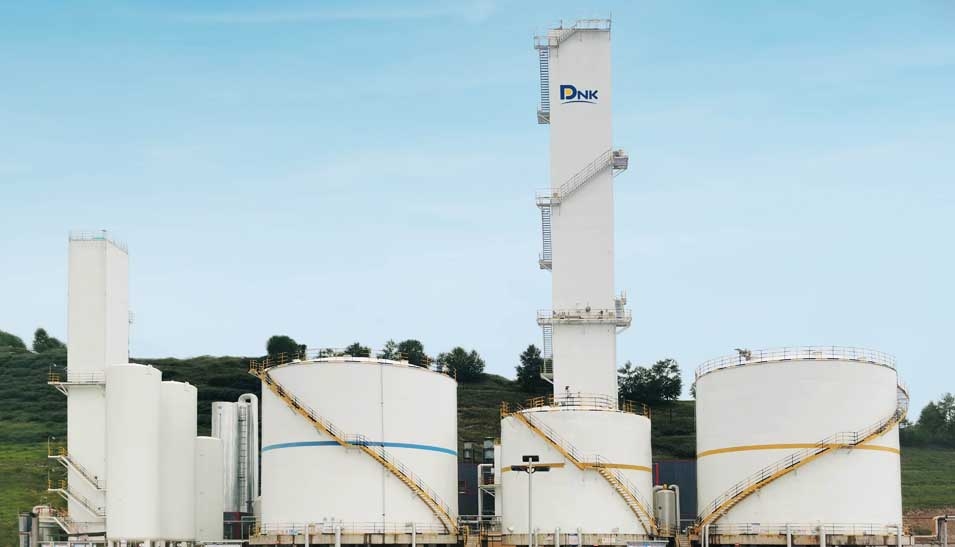
A full-liquid ASU primarily produces liquid oxygen (LOX) and liquid nitrogen (LIN). Liquid argon (LAr) can also be produced when the ASU incorporates an appropriate argon recovery and purification section and the product demand justifies the additional process scope. A full-liquid ASU should be designed around the required product mix, production capacity, product purity, operating conditions, cryogenic storage capacity, dispatch schedule, utility availability, and site conditions rather than capacity alone. DINAK can develop a project-specific solution based on the agreed product requirements, operating conditions, utilities, and site interfaces, with services including engineering, project management, construction, assembly, and technical training. Installation and commissioning responsibilities should be confirmed in the project-specific scope of supply.
Full Liquid ASU Requirements for Merchant Gas Production
Serving several industrial customers
A captive ASU is typically designed around the relatively stable gas and/or liquid product requirements of a specific industrial site or integrated production complex. A merchant industrial gas plant may serve customers with different demand profiles, product purities, delivery schedules, delivery volumes, and storage requirements. Its production basis must therefore combine several demand profiles instead of treating one customer's peak as the permanent plant load.
Balancing regular and seasonal demand
Merchant demand can change with customer maintenance periods, production campaigns, weather, and local industrial activity. Planning should examine normal dispatch, peak dispatch, low-demand periods, and the time available to rebuild inventory. The objective is not to predict every change, but to define a realistic operating envelope for production and storage coordination.
The ASU operating strategy should be evaluated against the expected demand range and storage inventory requirements. Product inventory can provide operational separation between continuous production and scheduled dispatch, but storage should not be treated as a substitute for an accurate demand forecast.
How Should a Full-Liquid ASU Product Mix Be Defined?
Planning liquid oxygen and nitrogen output
LOX and LIN demand may have significantly different commercial profiles, while the ASU production balance is determined by the selected process, operating conditions, product specifications, and recovery targets. The product mix should be based on customer applications, required product quality, dispatch frequency, and the commercial priority assigned to each liquid.
Deciding whether liquid argon is required
Liquid argon production can improve the commercial utilization of an ASU when sufficient argon demand exists and the selected process includes an economically justified argon recovery and purification system. Its inclusion affects process design, product handling, quality control, and storage interfaces. It should therefore be decided during the design-basis stage rather than added as an informal expectation.
How Does Production Connect with Storage and Dispatch?
Matching production with industrial storage interfaces
The full-liquid ASU, cryogenic liquid storage system, and truck-loading/transfer facilities should be designed as an integrated operating system. Production rate, available storage space, transfer timing, and product segregation must work together. If any interface is defined independently, the site can face avoidable restrictions even when the ASU itself is operating normally.
Planning Liquid Product Dispatch Facilities
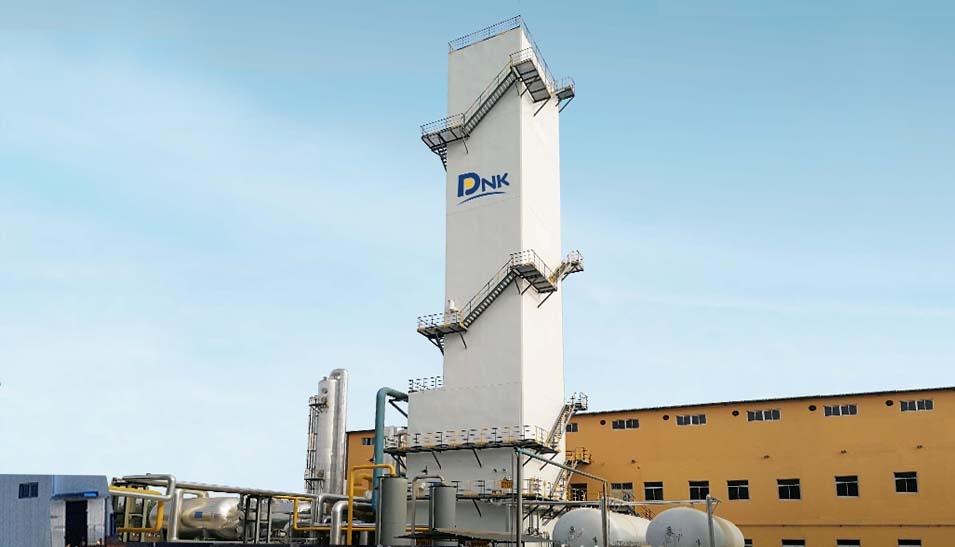
Dispatch planning begins with expected vehicle movements and the time required for safe cryogenic liquid transfer. Internal routes should keep process equipment accessible while separating logistics from restricted operating areas, with space for inspection and emergency access.
The transfer interface needs clear operating responsibility, product identification, monitoring, and communication with the control room. These details determine whether liquid production can move reliably into the downstream distribution system and belong in the same coordination process as the ASU.
Which Site and Utility Conditions Affect Full Liquid ASU Design?
Utilities and Site Conditions
A full-liquid ASU project needs a documented basis for electrical supply, cooling conditions, instrument services, drainage, ambient temperature, altitude, and raw-air conditions. These inputs affect equipment selection and the interfaces between process units. The design should use actual site information rather than values copied from an unrelated installation.
Utility availability also influences the practical operating plan. A plant intended for regular merchant supply must coordinate production expectations with power-system limitations and site support systems. Final equipment selection should be tied to the technical guarantee and the agreed utility boundary.
Layout and future development
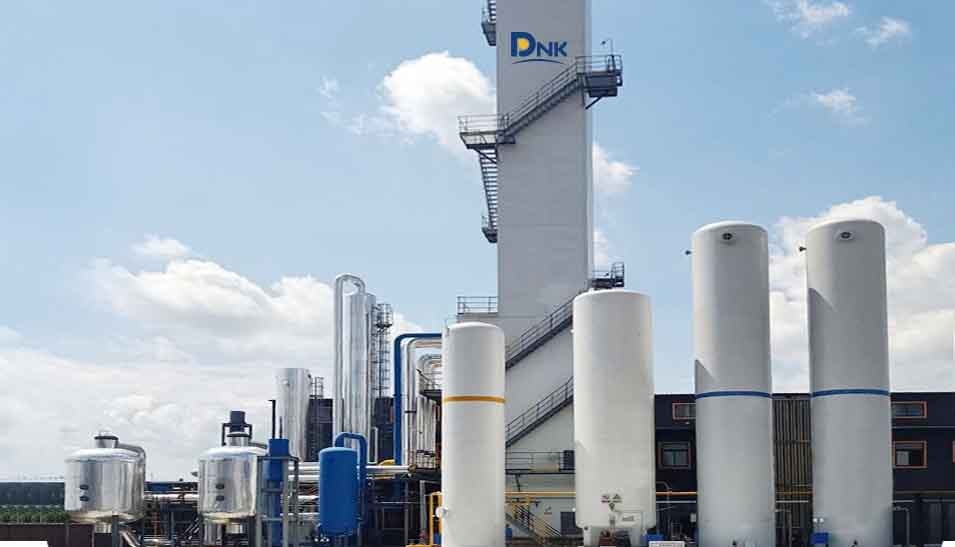
The cold box, process equipment, control area, industrial storage interface, transfer zone, and internal roads need a coordinated layout. Safe access and maintainable piping routes matter as much as optimizing equipment within the available plot area. A compact arrangement that obstructs inspection or dispatch can create long-term operating difficulties.
Future development should be considered through reserved interfaces, road planning, and a clear expansion basis. DINAK and the project owner should identify which provisions are included initially and which remain future decisions.
How Does DINAK Develop the Project Basis?
DINAK's service scope includes engineering, project management, construction, assembly, installation and commissioning, and staff training. The project documents should divide responsibilities for utilities, foundations, storage interfaces, transfer systems, controls, inspection, and performance acceptance. A clear battery limit reduces ambiguity when several contractors or site teams are involved.
Acceptance criteria should cover the product conditions and operating basis agreed for the project. They should also define testing responsibilities, instrumentation, required records, and the transition from commissioning to normal operation. General marketing statements cannot replace these project-specific commitments.
What Can Disrupt Merchant Gas Supply Planning?
Production and dispatch imbalance
A plant can experience an imbalance when liquid production continues but storage or dispatch capacity is constrained. The reverse can also occur when customer demand draws inventory faster than the agreed production plan can rebuild it. Scenario planning should show how operators respond to each condition without assuming an unconfirmed operating range.
Incomplete product-demand assumptions
A second risk is designing around customer interest that has not been translated into product specifications and dispatch commitments. Liquid type, quality, delivery frequency, and expected demand should be traceable to the commercial basis. Where information remains uncertain, it should appear as an assumption with an owner and a review date.
Merchant Gas Project Decision Matrix
The following comparison turns commercial demand into the technical questions that shape a full-liquid ASU project.
| Planning question | Effect on the project | Point to confirm with DINAK |
| Which liquid products are required? | Sets the product mix and process scope. | Liquid oxygen, nitrogen, and any argon requirement. |
| How does demand vary? | Shapes the operating and inventory basis. | Normal, peak, low-demand, and seasonal assumptions. |
| How often are products dispatched? | Affects storage and transfer coordination. | Dispatch pattern and production-to-storage interfaces. |
| Which utilities are available? | Constrains equipment and site integration. | Power, cooling, instrument services, and agreed boundaries. |
| What site layout is possible? | Influences access, piping, safety, and logistics. | Footprint, roads, restricted areas, and expansion provisions. |
| How will performance be accepted? | Defines the basis for project handover. | Product conditions, test method, instruments, and records. |
Conclusion
A full-liquid ASU is technically and commercially suitable when product demand, liquid mix, fixed storage interfaces, dispatch activity, utilities, and site layout are planned as one system. DINAK can use these project inputs to develop a project-specific engineering basis and define the appropriate ASU configuration.
Review DINAK's project services to prepare for the next technical planning discussion.
FAQ
Q: What products can a full-liquid ASU produce?
A: DINAK's full-liquid ASU materials describe liquid oxygen, liquid nitrogen, and liquid argon production. The actual product combination and output balance depend on the selected process, operating conditions, and project demand. Buyers should confirm each product's quality, form, acceptance conditions, and storage interface in the technical design basis.
Q: How should a merchant gas plant determine its product mix?
A: The product mix should follow documented customer demand, required product quality, delivery frequency, seasonal variation, and commercial priority. The project team should distinguish committed demand from possible future demand, then ask DINAK to evaluate a process balance under the agreed operating and utility conditions.
Q: Does every full-liquid ASU produce liquid argon?
A: No. Liquid argon requires a suitable process configuration and a market need that justifies the added scope. Its production should not be assumed from the full-liquid ASU label alone. Buyers should confirm argon quality, demand, process inclusion, storage interface, and acceptance requirements during project definition.
Q: What information should be prepared before discussing a project with DINAK?
A: Prepare the required liquid products, demand profile, quality requirements, operating schedule, dispatch pattern, storage interfaces, utilities, site conditions, layout constraints, responsibility boundaries, and acceptance criteria. This information gives DINAK a practical basis for discussing a customized full-liquid ASU without relying on unsupported standard assumptions.
-430x247.jpg)
内页小-430x246.jpg)